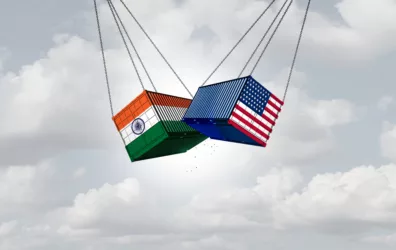
Washington, D.C.—On February 2, 2026, the Trump administration announced an agreement with Prime Minister Modi’s Indian government in which it says it will reduce tariffs immediately to 18% from 25%. In addition, the U.S. will drop its 25% penalty on India related to purchases of Russian oil that it imposed last year. In return, India has said it will reduce tariffs and non-tariff barriers against the U.S. to zero and will increase purchases of U.S. commodities and goods.
(Background: Perspectives on Tariffs: The Industry's India Conundrum)
This news comes on the heels of the announcement of the free-trade "mother of all deals" between India and the EU, announced last week, under which India will eliminate or reduce tariffs on 96.6% of EU exports, while the EU will do the same for 99.5% of Indian goods by trade value and the imminent ratification of a deal with the EU and Mercosur, also announced last week, in which tariffs are eliminated on over 90% of goods between the European Union and the South American bloc (Argentina, Brazil, Paraguay, Uruguay).
The deal between the U.S. and India, if and when made formal, will provide much-needed stability and predictability to supply chains that rely heavily on imported ingredients, especially herbs and herbal extracts from India. Not only is India a buffer against Chinese supply unpredictability, but many Ayurvedic herbs and other ingredients are only available from Indian sources.
Previously, some ingredients had been exempted as part of the Annex meant to provide tariff-free access for those goods not commercially available in the U.S., but treatment and tariff rates have been inconsistent, and the "Annex Exemption" solution has been problematic and certainly not stable. In fact, reports show a range of realities in U.S. imports from India. In a few cases, suppliers have absorbed the uncertainty. In other cases, the risk has been split between suppliers and distributors. In yet other cases, most, if not all of the tariff "implications" have been borne by brands and consumers. There have even been reports of buyers short-paying tariff line items on invoices.
Fundamentally, this is an unsustainable environment that is causing many businesses to hold off strategic and other long-term investments. On the India side, for many, there has been a recalibration of priorities, a shift to an EU or other focus, or patriation of manufacturing to countries with lower tariffs. And never before has having a superstar trade and customs broker been so essential to operations and profitability.
There are clearly geopolitical forces at work here. The administration can claim a clear victory with India foregoing Russian oil. U.S. access to India’s emerging middle-class, tariff-free or at lower tariffs is another victory, as is having a counterweight to China’s export power.
At some level, it doesn’t matter what the geopolitical motivations or victories are. Our natural products industry benefits from predictability and stability in import rules and costs. Provided this tariff reduction is implemented and the new thaw is maintained, expect a revitalization of India-U.S. trade, specifically in our industry, and expect it to propel growth in categories built on specialized India-sourced herbs and botanicals.