Continue To Site >
Quicklinks
  • Ask Whole Foods Mag
  • Magazine Subscription
  • View Back Issues
  • Advertise
  • Education Center
  • Ashwagandha / Shatavari Experience
  • Naturally Informed
  • Move Nutrition
  • India-America Boardroom Series
Free Newsletter Subscription
Ask WholeFoods Mag
  • News
    • All News
    • In Case You Missed It
    • Breaking News
    • Grocery News
    • Dietary Supplements News
    • Supplier News
    • Health & Beauty Aid News
    • Green News
    • Research
  • Features
    • Supplements
    • Grocery
    • Health & Beauty Aids
    • Suppliers
  • Columns
    • Debates
    • Editorial
    • Good Health Reads
    • Happy Customer
    • Herb of the Month
    • Leadership Profiles
    • Legal Tips
    • Mentors
    • Merchandising Insights
    • Recipes
    • Naturally Informed Education
    • The Nutrition Mythbuster
    • Trade Secrets
    • Vitamin Connection
    • What's Selling
    • WholeFoods Blogs
  • Products
    • Dietary Supplements
    • Grocery Products
    • Gourmet Products
    • Health & Beauty Aid Products
    • New Product Reviews
      • 2021 Archives
      • 2019 Archives
      • 2018 Archives
    • Suppliers
  • Multimedia
    • Videos
    • Podcast
    • The Natural View
  • Directory
Ask WholeFoods Mag
  • Log In
  • Register
  • Log Out
  • My Account
Free Newsletter Subscription
Quicklinks
  • Ask Whole Foods Mag
  • Magazine Subscription
  • View Back Issues
  • Advertise
  • Education Center
  • Ashwagandha / Shatavari Experience
  • Naturally Informed
  • Move Nutrition
  • India-America Boardroom Series
Home » Blogs » WholeFoods Magazine » Understanding the Google Search Engine Results Page

WholeFoods Magazine
WholeFoods Magazine RSS FeedRSS

All News
Phelps sarah morgan photography 0010 2

Jane Phelps is the CEO and co-founder of Know Agency, a digital marketing agency specializing in SEO, paid search, and AI visibility strategies for health and wellness brands. Since founding Know Agency in 2010, Jane has focused exclusively on the nutritional supplement industry, helping brands improve both traditional search performance and emerging visibility within AI-driven platforms. Jane is a public speaker and conference presenter at industry trade shows and events, where she speaks on AI, search, and digital marketing strategies for wellness and nutrition brands.


Understanding the Google Search Engine Results Page

Do you know what you’re seeing when you look at Google SERPs?

May 19, 2023
Jane Phelps, CEO, Know Agency
SEO-GettyImages-1303783209.jpg
Concept mobile browser application. Search bar. | Getty Images/iStockphoto

The Google search engine results page (SERP) can contain links, images, snippets, maps, questions and answers, and more. The search results depend on your search query and search intent.  

SEO, E-E-A-T, search intent, content quality, page experience, and customer demographics influence Google SERP content. The better you understand SERPs, the easier it is to create content, paid ads, and websites that rank at the top of the results page. 

Google SERP: Paid Search Results 

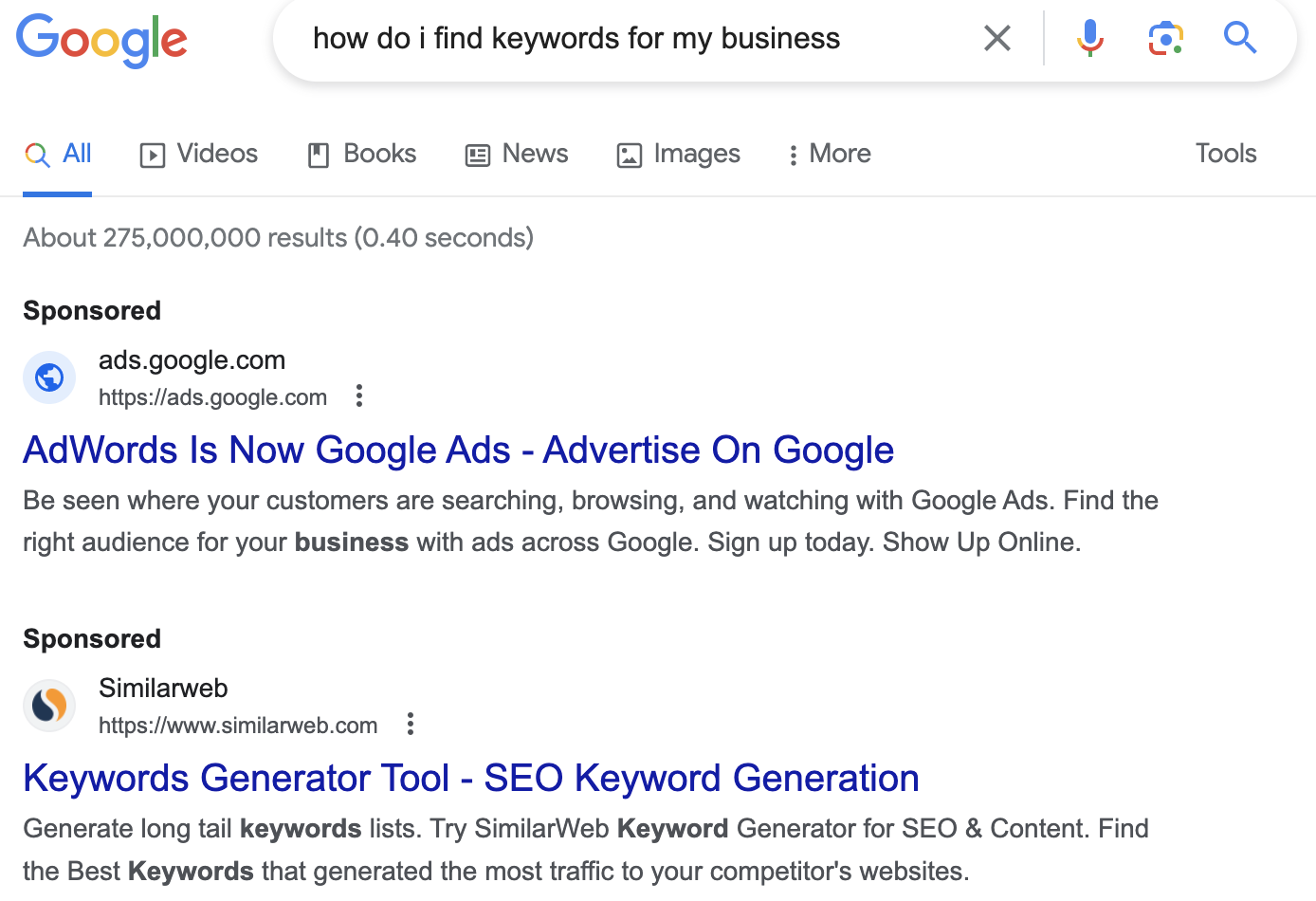
Typically, Google displays paid search results at the top of every SERP. Google identifies paid search ads with the word Sponsored. 
 

The search query and intent determines the types of ads Google displays.  
 
For example, asking “how do I find keywords for my business” returns text-based ads that include a URL, title link, and description.  
GoogleSearchKnowAgency.png


But a search query and intent that tells Google the customer is ready to buy “keto cookie dough” returns image-based ads, including the product image and shopping details.


In both examples, the top ranking paid ads were optimized for:

  1. Keywords
  2. Search intent
  3. Google search data
  4. Competitive advantage

Google SERP: Organic Search Results

Google defines organic search results as: a free listing in Google Search that appears because it’s relevant to someone’s search terms.

Organic search results typically display directly below paid search results or as the top search result. These results make up the majority of the SERP content, displaying up to 60 search results if you’re searching on your computer.

Every organic search result includes a URL, title, and description. And depending on the search query and intent, may include images, videos, maps, and relevant search queries or additional helpful information. 

For example, this screenshot shows the organic search results for the branded search query phrase “quantum nutrition labs probiotic”. These organic search results display directly below paid search results for probiotics.


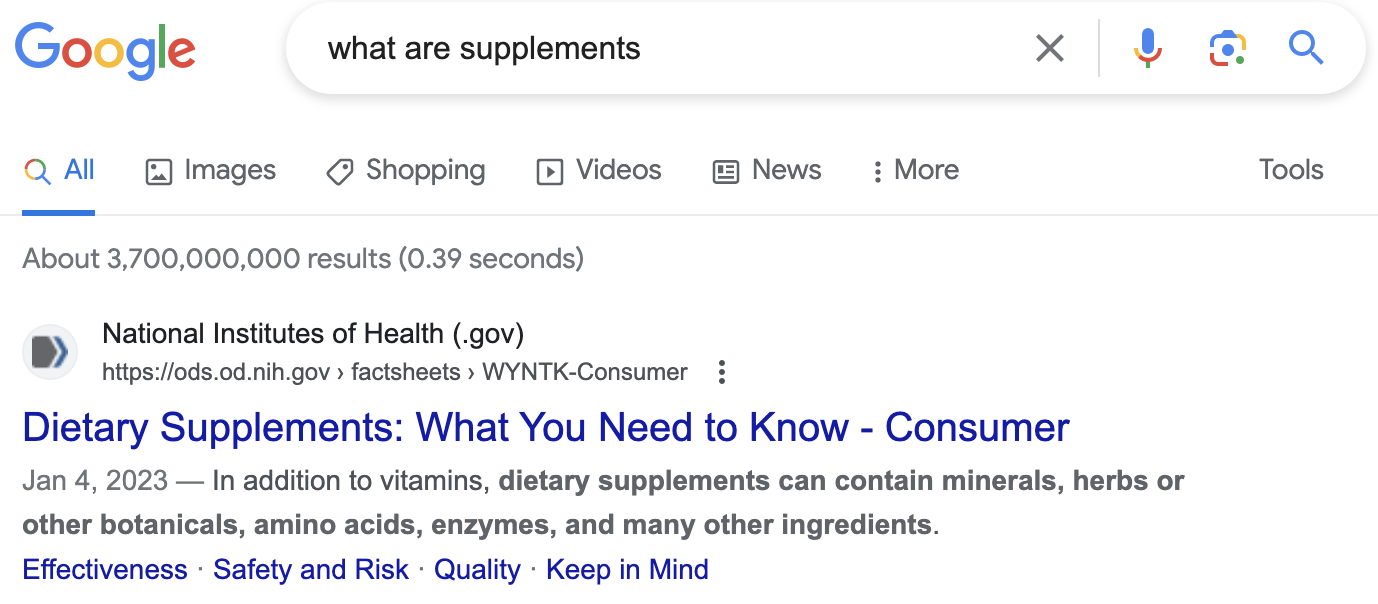
And the less specific search query below asking “what are supplements” generates a different organic search result. Notice that this organic search result has the top position in the SERP. 
WhatAreSupplementsKnowAgency.png


Googles uses ranking factors to determine what it displays and the order of the organic search results.

Key Google ranking factors include: 

  • Search query and search intent relevance
  • Domain and page authority
  • Keyword optimization
  • Quality and helpful content
  • Website loading speed, structure, and mobile friendliness

Google SERP Feature: People Also Ask

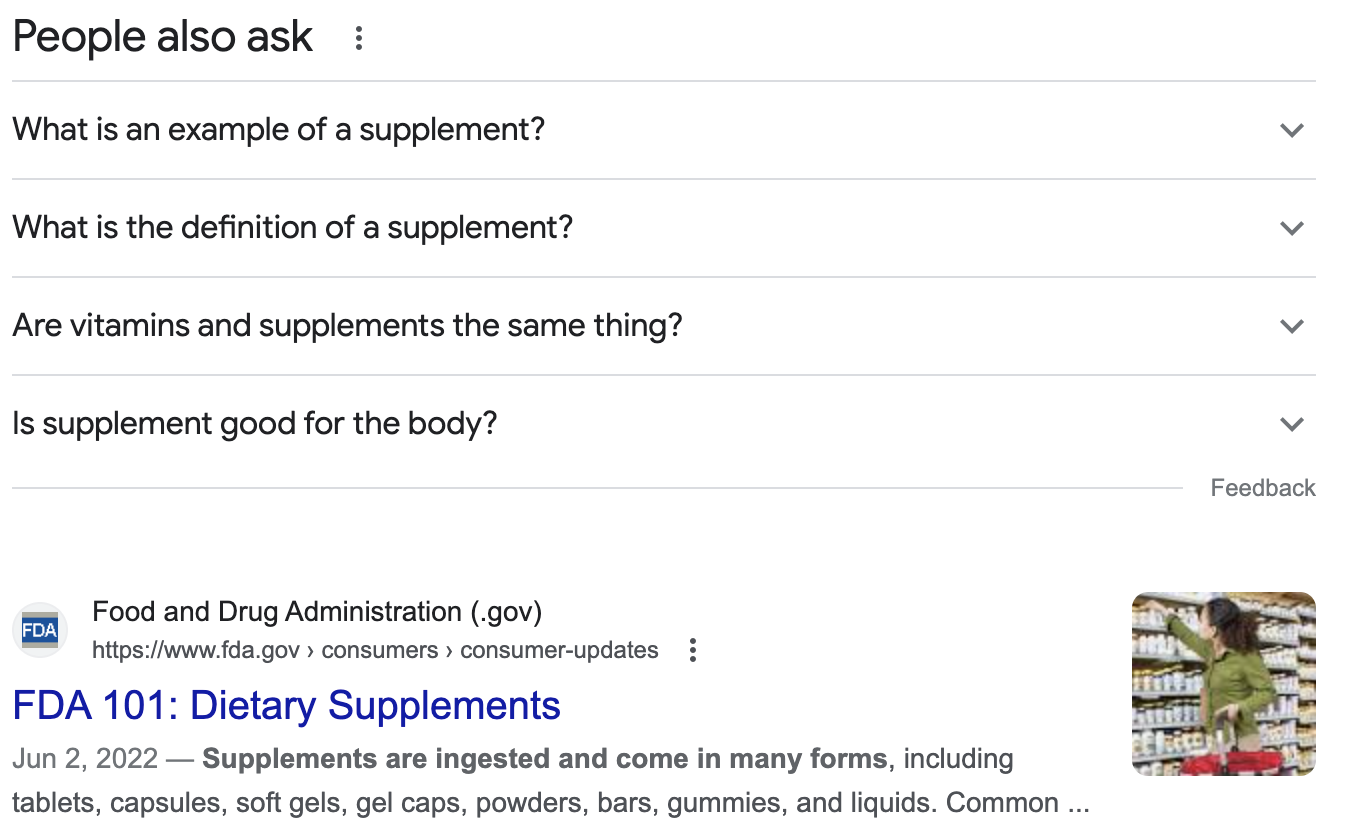
People Also Ask boxes typically display below paid search results and below the first organic search result. Google populates this rich snippet feature with questions related to the original search query and intent. 

Every People Also Ask section includes four questions. More questions are added as you click and expand a question. Google adds follow-on questions based on the question you expand. 

For example, here is the People Also Ask section for the search query “what are supplements,” including the organic search result directly below these questions. 
WhatAreSupplmenentsKnowAgency.png


And below is what happens when I expanded the first question in the People Also Ask section. 
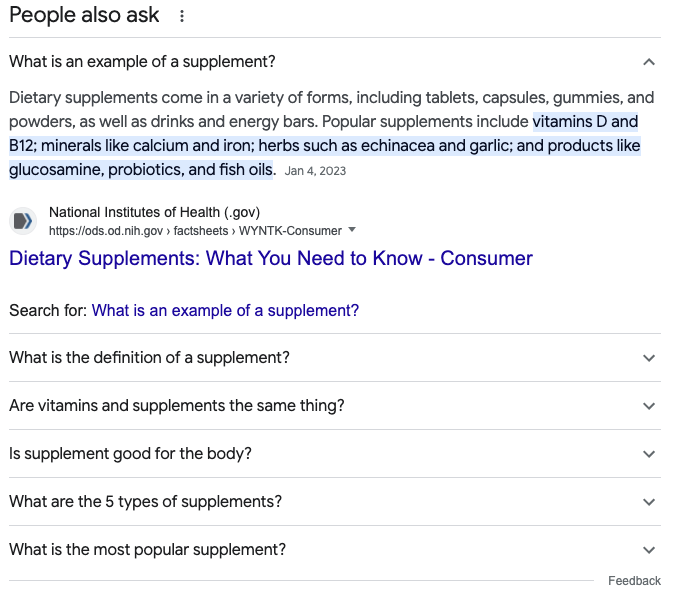
PeopleAlsoAskKnowAgency.png

Along with answering the question and highlighting the most important information, Google includes an additional search query and adds more questions to the People Also Ask section. 

To optimize your content for the People Also Ask section, do the following:

  1. Research your competitors and identify their information gaps. Use a branded search query for your competitors and see what appears in the People Also Ask section. This tells you the problems and challenges people are having and what cannot be answered on competitor websites. 
  2. Create an FAQ based on relevant People Also Ask questions for your primary keyword phrase. Organize these in a Q and A format, and make sure the first sentence answers the question. Hint: Talk to your web team and ask them to format these FAQs with Google’s FAQPage schema.
  3. Search for your keyword phrases and create content to answer the questions in the People Also Ask section.

Make sure you pay attention to the additional search queries Google displays. This tells you a lot about customer search habits and the types of information they want.

  1. Remember the keys to writing high-quality helpful content:
  • Answer questions clearly and succinctly 
  • Use bulleted and numbered lists to organize content
  • Use questions in your sub headings (H2s)
  • Optimize images with alt text, descriptive names, and captions


What’s In the Google SERP for Your Keyword?

Open Google and type your keyword phrase. 

Where do you rank? What are the questions in the People Also Ask section? Who is winning the top paid search result and organic search result? What do the search results look like – are there images, maps, videos? Make sure you have the content formats that Google displays.

Before you create a paid search ad, write a landing page, publish a blog, or add a new page to your website – do your research in Google Search. You need to know what Google considers to be important for your target keywords.

The more you know about what Google wants, the easier it is for you to give this to Google and your customers.
Recommended For You
Latest Publication
Screenshot_2026-05-26_at_7.47.16_AM.jpg
June/July 2026
CovHeart.jpg
2026 Deep Dive Cardiovascular Health
Screenshot_2026-04-16_at_11.51.39_AM.png
May 2026
CovMi26.jpg
2026 Mastering the Microbiome Market
Most Popular
  • DOP Venkat8707T01.JPG

    KSM-66 Ashwagandha/Shatavari Experience: Explore Shatavari

    By WholeFoods Magazine Contributor
    June 9, 2026
  • Fostering mental wellness.

    The Pillars of Mental Resilience

    By Jennifer Joseph
    June 1, 2026
  • GettyImages-1356683353.jpg

    In Memoriam: John James Mastel Sr., Founder of Mastel's Health Foods

    By Richard Ortega, Associate Editor, WholeFoods Magazine
    June 9, 2026

WholeFoods Magazine is your one-stop resource for health and nutrition articles. We provide important information regarding industry news, research, and trends.

The Magazine

  • Current Issue
  • Subscribe
  • Renew
  • Change of Address

Information

  • Source Directory
  • Helpful Resources
  • Job Finder

About Us

  • About Us
  • Contact Us
  • Advertise

Social

NOTE: WholeFoods Magazine is a business-to-business publication. Information on this site should not be considered medical advice or a way to diagnose or treat any disease or illness. Always seek the advice of a medical professional before making lifestyle changes, including taking a dietary supplement. The opinions expressed by contributors and experts quoted in articles are not necessarily those of the publisher or editors of WholeFoods.

© Copyright 2026 WFC, Inc. All Rights Reserved.
Privacy PolicyTerms