Continue To Site >
Quicklinks
  • Ask Whole Foods Mag
  • Magazine Subscription
  • View Back Issues
  • Advertise
  • Education Center
  • Ashwagandha / Shatavari Experience
  • Naturally Informed
  • Move Nutrition
  • India-America Boardroom Series
Free Newsletter Subscription
Ask WholeFoods Mag
  • News
    • All News
    • In Case You Missed It
    • Breaking News
    • Grocery News
    • Dietary Supplements News
    • Supplier News
    • Health & Beauty Aid News
    • Green News
    • Research
  • Features
    • Supplements
    • Grocery
    • Health & Beauty Aids
    • Suppliers
  • Columns
    • Debates
    • Editorial
    • Good Health Reads
    • Happy Customer
    • Herb of the Month
    • Leadership Profiles
    • Legal Tips
    • Mentors
    • Merchandising Insights
    • Recipes
    • Naturally Informed Education
    • The Nutrition Mythbuster
    • Trade Secrets
    • Vitamin Connection
    • What's Selling
    • WholeFoods Blogs
  • Products
    • Dietary Supplements
    • Grocery Products
    • Gourmet Products
    • Health & Beauty Aid Products
    • New Product Reviews
      • 2021 Archives
      • 2019 Archives
      • 2018 Archives
    • Suppliers
  • Multimedia
    • Videos
    • Podcast
    • The Natural View
  • Directory
Ask WholeFoods Mag
  • Log In
  • Register
  • Log Out
  • My Account
Free Newsletter Subscription
Quicklinks
  • Ask Whole Foods Mag
  • Magazine Subscription
  • View Back Issues
  • Advertise
  • Education Center
  • Ashwagandha / Shatavari Experience
  • Naturally Informed
  • Move Nutrition
  • India-America Boardroom Series
Home » Blogs » WholeFoods Magazine » How Search Intent Unlocks Customer Challenges and Desires 

WholeFoods Magazine
WholeFoods Magazine RSS FeedRSS

Tip of the Month
Phelps sarah morgan photography 0010 2

Jane Phelps is the CEO and co-founder of Know Agency, a digital marketing agency specializing in SEO, paid search, and AI visibility strategies for health and wellness brands. Since founding Know Agency in 2010, Jane has focused exclusively on the nutritional supplement industry, helping brands improve both traditional search performance and emerging visibility within AI-driven platforms. Jane is a public speaker and conference presenter at industry trade shows and events, where she speaks on AI, search, and digital marketing strategies for wellness and nutrition brands.


How Search Intent Unlocks Customer Challenges and Desires 

Learn why search intent is critical to customer satisfaction.

April 8, 2023
Jane Phelps, CEO, Know Agency
Engaging content marketing. vector illustration business concept.mix social media sharing.flat advert banner design presentation website template background
Getty Images/iStockphoto

Search intent is the need, challenge, goal, or question your customer wants to solve.  

Search intent compels people to open a web browser and type their question, query, or phrase.  

For example, your customers want to know more about protein powder. So, they open a web browser and type best protein powder for women over 50 or what is protein powder? or buy protein powder Atlanta.  

Each of these is an example of search intent. The subtle differences in phrasing tell you where the customer is in the customer journey.  

When you know search intent, you can learn more about your customers, ultimately giving them the content, they want and need. This is how you provide helpful content – the content that makes Google happy and builds trust with your customers.  

 As a Your Money Your Life (YMYL) website, it’s critical you always provide helpful content.

The 4 Types of Search Intent  

 The 4 types of search intent are: 

  1. Informational: The person wants information and is in the early stages of learning about your product or subject area. For example, protein powder for women over 50.
  2. Commercial: The person knows what they want but needs more information before buying. They make be looking for reviews, comparison charts, and the best deals. For example, best protein powder for women over 50. 
  3. Transactional: The person is ready to buy and is looking for the best product/service and place to buy it. For example, buy best protein powder for women over 50.  
  4. Navigational: The person is looking for a specific website. Instead of typing a URL, they type the company name, brand or product in the search box. For example, Vega. 

Remember, satisfying search intent is Google’s number one priority. To rank high in the search engine results, you must optimize for search intent.  

4 Steps to Discovering Search Intent 

Do this to discover search intent: 


1. Study search engine results 

Open Google and type your keyword phrase. Take a close look at the search results.  

What type of content is returned? Click links, read the content – is it helpful, does it answer questions, solve problems, offer solutions, etc.?  

What questions are listed in the People Also Ask section? These are search queries that Google believes can help you learn more or maybe even give you the answer you’re looking for.  

In the Google search bar, click next to your keyword phrase, and look at the additional search terms and queries displayed. These tell you how people are searching for your keyword phrase and the questions they have.  

Scroll down and review the Related Searches section. Depending on your search phrase, this section may list products, reviews, and additional search phrases and keywords.  
2. Research your keywords


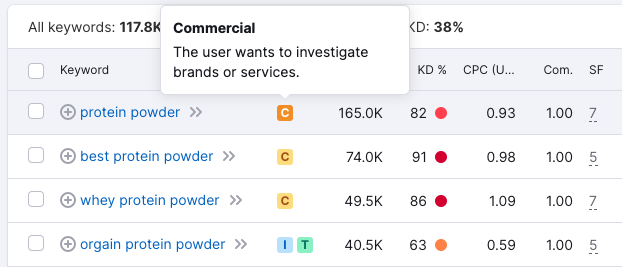
Use a tool like SEMrush to learn more about your keywords and to see the search intent behind your keywords. Dig into the data to learn about keyword variations, related keywords, search volume, and the type of content ranking for this keyword.

Search intent is the need, challenge, goal, or question your customer wants to solve.

3. See how people are using your keywords


Tools like AlsoAsked.com and AnswerThePublic.com give you a visual map of your keywords and related searches. Both tools use data from Google search results to give you more insight into how people use your keywords.

4. Ask ChatGPT for its opinion on your keyword phrase


ChatGPT can tell you the search intent behind your keyword phrase. But due to the volatility of ChatGPT, this should be the last thing you do.

For example, in ChatGPT you could type the following prompt: Can you provide me with information about search intent for this keyword phrase: protein powder for women over 50?
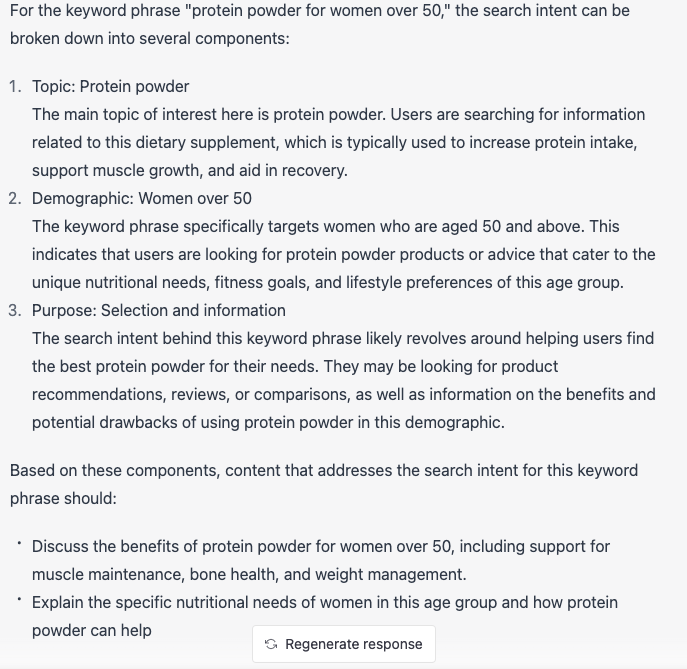
Here is a sample of what ChatGPT returns:


How to Optimize for Search Intent 

To optimize for search intent, you need to put the customer first.

  • What does the customer want and need? You cannot give the customer a half answer. You need to fully understand their challenge and give them content that solves this.  
  • What type of search intent are you writing for? The search intent type and keyword phrase should guide the type of content you create. Look at the content ranking high in the search results – this content is likely meeting search intent.  
  • What is your point of view for the content? Every piece of content needs to have a point of view. This is how you showcase your experience, expertise, authoritativeness, and trust (E-E-A-T).  
  • How is the content delivered? Blogs, guides, whitepapers, videos, infographics, etc. Make sure you get the content format right.

A Search Intent Checklist for Health and Wellness Brands 

Use my 4-step search intent checklist to help you put your customers first: 

  1. Look at the search engine results. What are people searching for? 
  2. Read the top-ranking content. How is the content formatted and what are the key takeaways? 
  3. Know what you want to say. What is your answer or solution and how is this unique from your competitors? 
  4. Put the customer first. How does this help the customer? Is this easy to read and understand? 

You need to know your customers.   

Answer their questions. Help them make decisions. Support them. Have the answers.

Related: ChatGPT and Health and Wellness Brands: What You Need to Know

Essential SEO Tactics You Need to Know


Recommended For You
Latest Publication
Screenshot_2026-05-26_at_7.47.16_AM.jpg
June/July 2026
CovHeart.jpg
2026 Deep Dive Cardiovascular Health
Screenshot_2026-04-16_at_11.51.39_AM.png
May 2026
CovMi26.jpg
2026 Mastering the Microbiome Market
Most Popular
  • Anaheim Convention Center hosted four days of innovation, education, networking, and trendspotting at Expo West 2026.

    Expo West 2026 Trend Report: Innovation, Transparency & Functional Wellness

    By WholeFoods Magazine Staff
    May 26, 2026
  • Fostering mental wellness.

    The Pillars of Mental Resilience

    By Jennifer Joseph
    June 1, 2026
  • Yogurt-probiotics-GettyImages-2217529941.jpg

    Rethinking Lactose Intolerance: The Role of Probiotics and Prebiotics

    By Clare Fleishman, MS RDN
    May 22, 2026

WholeFoods Magazine is your one-stop resource for health and nutrition articles. We provide important information regarding industry news, research, and trends.

The Magazine

  • Current Issue
  • Subscribe
  • Renew
  • Change of Address

Information

  • Source Directory
  • Helpful Resources
  • Job Finder

About Us

  • About Us
  • Contact Us
  • Advertise

Social

NOTE: WholeFoods Magazine is a business-to-business publication. Information on this site should not be considered medical advice or a way to diagnose or treat any disease or illness. Always seek the advice of a medical professional before making lifestyle changes, including taking a dietary supplement. The opinions expressed by contributors and experts quoted in articles are not necessarily those of the publisher or editors of WholeFoods.

© Copyright 2026 WFC, Inc. All Rights Reserved.
Privacy PolicyTerms