The prebiotic category has arrived. You can see it in grocery aisles, clinical protocols, mainstream snack brands, and practitioner formulations. That’s clear progress. Whether the industry builds on it responsibly is a question the category now has to answer.
At the Global Prebiotic Association (GPA), we see the signal clearly in shifting consumer motivations. While gut health remains the top driver in the U.S., other motivations are emerging. According to Industry Transparency Center (ITC) consumer data, interest is growing across immunity, metabolic health, brain health, and stress support. Among younger men in particular, athletic performance is a meaningful and growing use case. GLP-1–adjacent prebiotic positioning is also accelerating, with consumers looking for support both during use and as they transition off these medications.
Consumers are no longer approaching prebiotics as a gut-only solution.
They are using them for specific reasons, with distinct outcomes in mind, and the industry needs to meet them with positioning that matches that specificity.
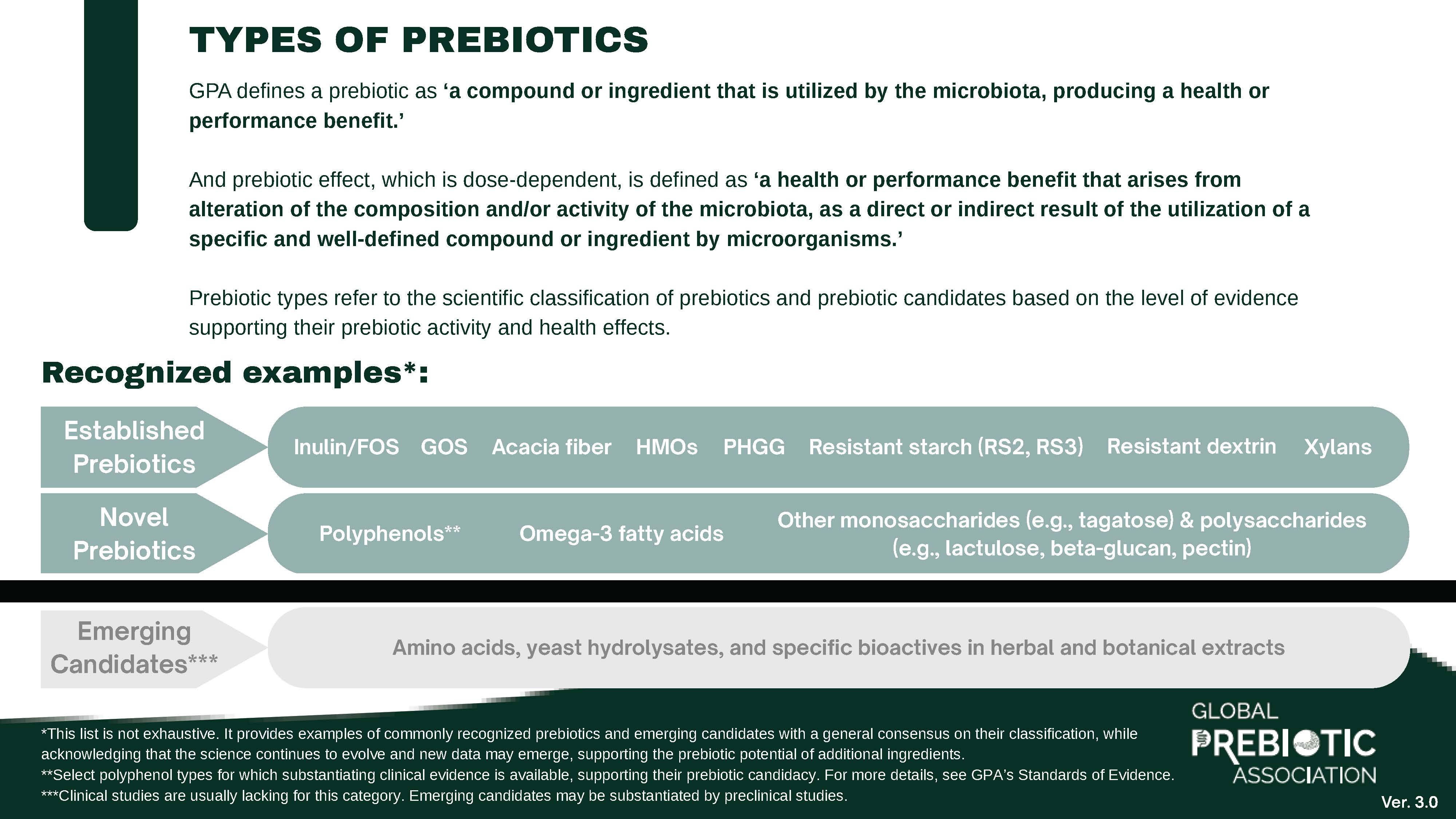
As the category has grown, so has the range of ingredients carrying the prebiotic label. The landscape now extends well beyond traditional inulin and FOS to include resistant starches, resistant dextrins, XOS, GOS, and a growing range of novel and upcycled plant-derived substrates. Applications have followed, spanning sports and performance, the gut-brain axis, synbiotic formulations, and clinically dosed practitioner products.
This expansion represents real progress, but it has also created a real issue with ingredient selection, dose, and formulation not always aligning with what the label claims. The gap between implied benefits and supported evidence poses a significant risk to credibility.
Prebiotics are not interchangeable.
Ingredient type, dose, and context of use matter, especially as products move from general wellness into more targeted claims. A beverage designed for everyday fiber support is not the same as a formulation intended to support metabolic health or GLP-1–related side effects. The category supports both, but the evidence has to be as explicit as the claims being made.
What GPA is advocating for is moving toward greater category discipline, and ultimately, toward a harder problem to solve: precision.
Organizations like ISAPP and GPA have each done the foundational work by defining what a prebiotic actually is and establishing what it takes to demonstrate a prebiotic effect. These are not identical frameworks, but they share the same goal, a rigorous, evidence-grounded basis for what the category claims to do.
At GPA, we’re genuinely excited about where this leads. True precision, matching the right prebiotic ingredient to the right individual based on their specific microbiome composition and species profile, is where the category can ultimately go. Getting there depends on advancements in microbiome sequencing and diagnostics that are not yet widely available or standardized. The definitional and evidence work happening now is the prerequisite. When the science catches up, the industry needs to be ready.
That readiness starts with discipline today. If the term continues to be stretched beyond what the evidence supports, the foundation that precision depends on becomes harder to build from. The category’s long-term credibility, and its most exciting potential, depend on holding that line now.
Expansion brought visibility. Evidence provides structure. Precision is the next frontier, and it’s one the prebiotic category is positioned to reach.