
Quicklinks
Less is More: More Results, Less Medicine

Matt, Herbal Head Honcho
Since the time of Hippocrates of Kos, one of the first precepts of physicians has been “First, do no harm.” The physician’s job is always, first, and foremost, to minimize risk. Would you go to a surgeon who doesn’t sterilize his instruments before surgery? Of course not. Yet most patients, and many doctors, do not really understand or appreciate the risks and tradeoffs of the drugs they use.
In America, we are obsessed with what we perceive to be the “best.” But does it really matter which wrench is the “best” in the toolbox? In real life, smart professionals use a variety of tools to get any job done safely and well. And they don’t buy their tools by the pound, like it’s gravel or nails.
Fig. A:
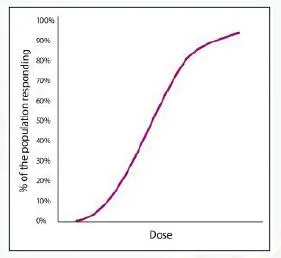
Modern pharmacology is built on the concept of the population-based dose-response (PBDR) curve, which looks something like Fig. A. There are a few important things to notice about this curve:
- In this model, the effect (on the vertical axis) is measured as a percentage of the population. The does that helps 50% of people is halfway up the graph (and exactly what help means is a separate subject).
- A medicine that helps 90% of the population sells twice as fast as one that helps 45%. Bigger doses mean more customers and more money.
- The curve slopes up right, meaning more medicine causes a larger effect.
- The curve is steepest in the middle, and flattest near the top, showing diminishing returns with ever-increasing doses.
- It takes a lot more medicine to get from 90% to 95% than it takes to get from 45% to 50%.
- The scale is often logarithmic, where each horizontal grid mark is 10 times the prior one—so when we say “more medicine” we may actually mean 10-50 times more medicine.
There’s also a very important consideration that you DON’T see in a PBDR curve—the side effects, which also increase with dosage. With higher doses, side effects are both 1) more frequent and 2) more severe. Unfortunately, you can’t pick up one end of the stick (the effect you want) without picking up the other end of the stick (the side effects you don’t).
In western science, we assume there is one “best” treatment for every disease (it makes science and math easier, for example). This is only an assumption. At the pioneering edges of modern medicine, the one-target, one-treatment, or “silver bullet” drug model is only now starting to be questioned by doctors who treat those who are most at risk from the current model. Physicians are often finding that smaller doses of several medicines seem to be both safer and more effective, than one drug alone.
In Traditional Chinese medicine (TCM), combination formulas are the rule, not the exception—and there are over 10,000 formulas to choose from. TCM literature is very clear about using combinations of smaller doses.
In the first part of the 20th century, the American Eclectic schools of herbal medicine were split right down the middle on this. Some wanted to follow the “silver bullet” approach. Others favored a more complex and traditional approach. As a result, they were steamrolled by the rising conventional medical establishment. By 1939, the last Eclectic herbal medical school (in Cincinnati, OH) closed its doors.
Today, the silver bullet approach faces new scrutiny. Americans are wary of dangerous and ineffective “approved” drugs. The system as it is has created relatively few choices, astronomical drug prices, and financial incentive to avoid drugs for rare diseases. Is this really the best that modern medicine can offer? Can’t we expand our toolbox with support from more traditional methods that have worked for thousands of years?
Today, several American herbal companies are once again raising the flag of Eclectic herbalism—RidgeCrest Herbals is only one of them. Our unique method of Portfolio formulation® includes several traditional and modern techniques designed to get better results from smaller and fewer capsules. After all, herbal remedies are tools—not nails.
Fill out the form below to download the video, where you will learn about the Ridgecrest Herbals ClearLungs Line, including SPORT and Immune products.
Content Sponsored by Ridgecrest Herbals
*These statements have not been evaluated by the Food and Drug Administration. These products are not intended to diagnose, treat, cure, or prevent any disease.
Education Center Video

Recommended For You
Latest Publication
June/July 2026
2026 Deep Dive Active Nutrition Market

2026 Deep Dive Cardiovascular Health
May 2026